← Projects

AI Agent for Non-Technical Website Management

AI AgentPythonRaspberry Pi
A client wanted to publish their daily biblical readings online and share them with their community. The problem: they had no technical background and found every existing website management tool too complex to use independently.
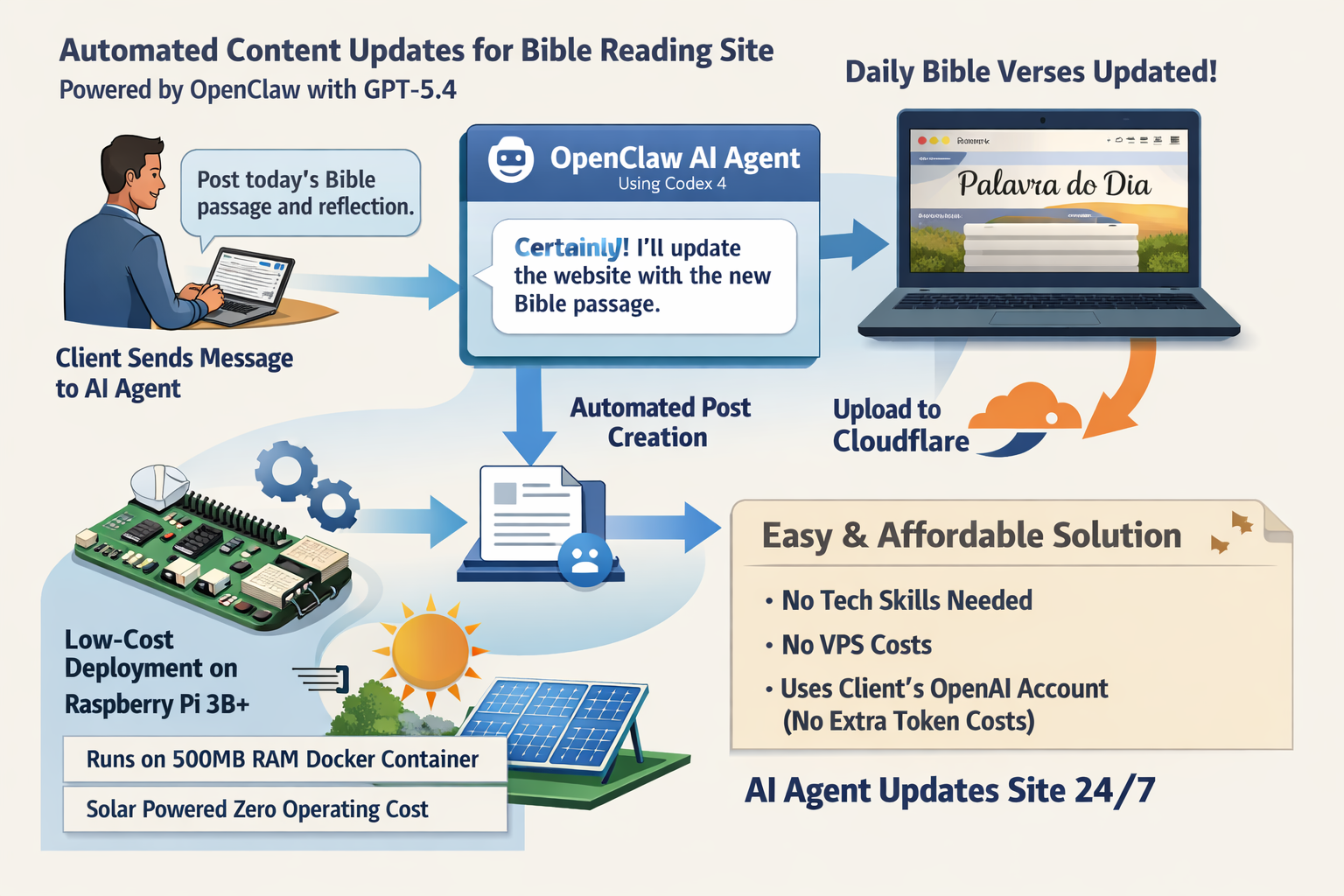
System architecture — OpenClaw agent on Raspberry Pi updating Cloudflare Pages via the client's OpenAI account
Overview: client sends a message → OpenClaw agent (Raspberry Pi) → automated site update → Cloudflare Pages
The solution was to give them something they already knew how to use: a chat interface. By deploying an AI agent on a Raspberry Pi connected to the client's own OpenAI account, the client can now update, restructure, and manage their entire website simply by sending plain-language messages. No dashboards, no logins, no technical knowledge required. The solution relies on three interconnected layers: a conversational AI agent that understands plain-language instructions, a low-cost always-on server to host it, and a serverless platform to publish the result. Together they form a pipeline that turns a chat message into a live website update, with no human intervention beyond the client's original request. The system is built around three components:
  • AI Agent (OpenClaw): A containerized agent running on the Raspberry Pi. It interprets the client's messages, makes the necessary changes to the site files, and triggers a new deployment to Cloudflare Pages.
  • Raspberry Pi 3B+: Acts as the always-on server. A custom Docker image was built and optimized to run the agent within 500 MB of RAM, well within the 1 GB limit of the Pi 3B+.
  • Cloudflare Pages: Hosts the static site on the free tier. The agent commits and pushes changes, and Cloudflare automatically rebuilds and publishes the updated site.
The client interacts with the agent entirely through chat messages. The agent handles the rest. Every change made by the agent is committed to a GitHub repository with a descriptive message, creating a full version history of the site. This means any update can be reverted instantly if needed, and the codebase remains accessible to developers for future technical modifications or feature additions, without compromising the simplicity of the client's chat-based workflow.
  • No VPS needed: The Raspberry Pi 3B+ replaces a cloud server entirely, eliminating monthly hosting costs.
  • Optimized Docker image: The custom image was tuned to use only the resources strictly necessary, keeping memory usage under 500 MB and enabling stable operation on commodity hardware.
  • Ultra-low power draw: The Raspberry Pi 3B+ consumes approximately 2 W at idle. Running 24/7 at 0.30 EUR/kWh, the annual electricity cost is roughly 7 EUR/year.
  • Effectively zero operating cost: The client has a solar panel installation, so the real cost of running the agent is €0/year beyond the one-time hardware purchase.
  • No extra API costs: The agent is connected directly to the client's own OpenAI account (openai-codex / GPT-5.4). There is no intermediary layer adding markup to API usage.
  • Zero technical knowledge required: The client operates the system entirely through conversational messages, just as they would send a text.
  • OpenClaw: Agent framework, containerized via Docker
  • Docker: Custom image with external volume mounts and resource constraints
  • Raspberry Pi 3B+: ARM hardware, 1 GB RAM, 2 W idle
  • OpenAI API (openai-codex / GPT-5.4): LLM backbone, billed directly to the client's account
  • Cloudflare Pages: Static site hosting, free tier, automated deployments via Git
The main technical challenge was fitting the agent into the hardware constraints of the Raspberry Pi 3B+. Standard Docker images for AI agents tend to be heavy. This required careful selection of base images, removal of unused dependencies, and configuration of Docker volume mounts to keep the persistent data outside the container layer, reducing both image size and RAM footprint. Resource limits were set explicitly in Docker Compose to prevent the agent from consuming more memory than the system could provide, ensuring stable long-term operation without intervention. This project illustrates a broader point: AI agents are not just tools for engineers. With the right deployment strategy, they can act as a technical proxy for anyone, making it possible for a non-technical person to manage a live website as naturally as sending a message to a friend. The Raspberry Pi deployment model also challenges the assumption that always-on agents require cloud infrastructure. For many small-scale use cases such as personal sites, community pages, or local businesses, the hardware is likely already available, and the ongoing cost is negligible. Projects like this demonstrate how AI agents can genuinely democratize access to the web, putting tools that once required technical expertise into the hands of anyone with something to say.